Workers’ Health under Climate Change: Agrochemicals
Infographic · Agrochemicals · Brazil · CLIDEWO
Agricultural workers are regularly exposed to agrochemicals — pesticides, herbicides, fertilisers — through skin contact, inhalation, and contaminated food and water. Short-term effects include skin irritation, eye problems, headaches, and respiratory difficulty. Long-term exposure is linked to chronic respiratory disease, hormonal disruption, reproductive problems, nerve damage, and elevated cancer risk. Limited access to protective equipment and training amplifies these risks.
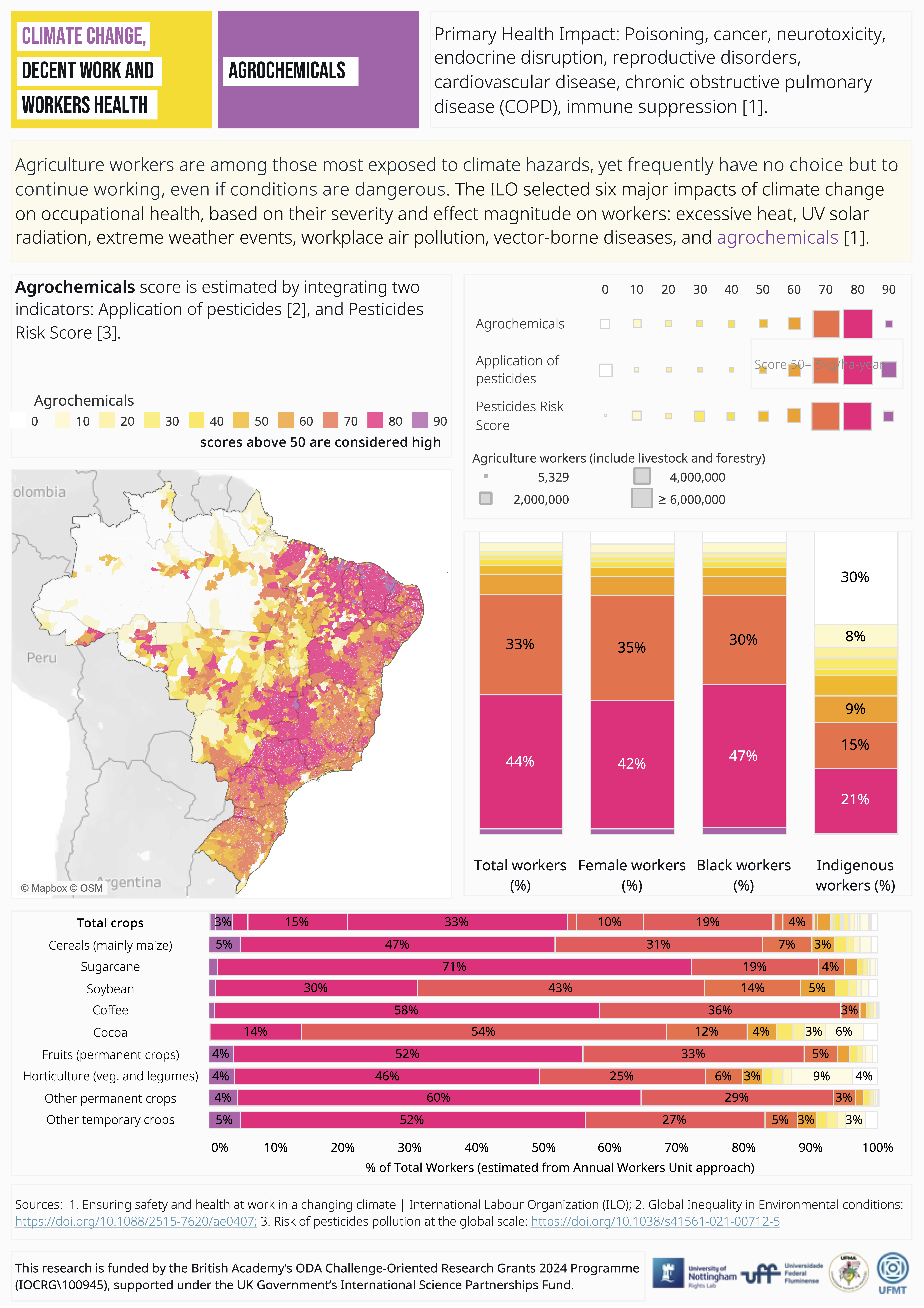
Agrochemicals score
The agrochemicals score integrates two indicators:
- Application of pesticides — sourced from Ormaza-Zulueta & Mehrabi (2025), Environmental Research Communications1
- Pesticides risk score — sourced from Tang et al. (2021), Nature Geoscience2
The visualisation summarises agrochemical exposure risk in Brazil, disaggregated by municipality, population, and crop type, to identify spatial differences and exposure hotspots. By translating complex climate and socio-environmental data into accessible visual formats, it supports targeted interventions and risk-informed policy.
About this series
This infographic is part of a nine-piece series on climate hazards and workers’ health, developed for the CLIDEWO project. The series draws on the framework set out in the ILO’s Ensuring Safety and Health at Work in a Changing Climate (2024).3
Footnotes
Ormaza-Zulueta, N. & Mehrabi, Z. (2025). Global inequality in environmental conditions underpinning human rights. Environmental Research Communications, 7, 095017. https://doi.org/10.1088/2515-7620/ae0407↩︎
Tang, F.H.M., Lenzen, M., McBratney, A. & Maggi, F. (2021). Risk of pesticide pollution at the global scale. Nature Geoscience, 14, 206–210. https://doi.org/10.1038/s41561-021-00712-5↩︎
International Labour Organization (2024). Ensuring safety and health at work in a changing climate. https://www.ilo.org/publications/ensuring-safety-and-health-work-changing-climate↩︎